
A Game That Carried a Culture
Bid Whist isn't just played in Black American families — it's kept. Passed down like recipes and stories, carried on rail lines and through migrations, defended like an heirloom. This is that history — with the receipts.
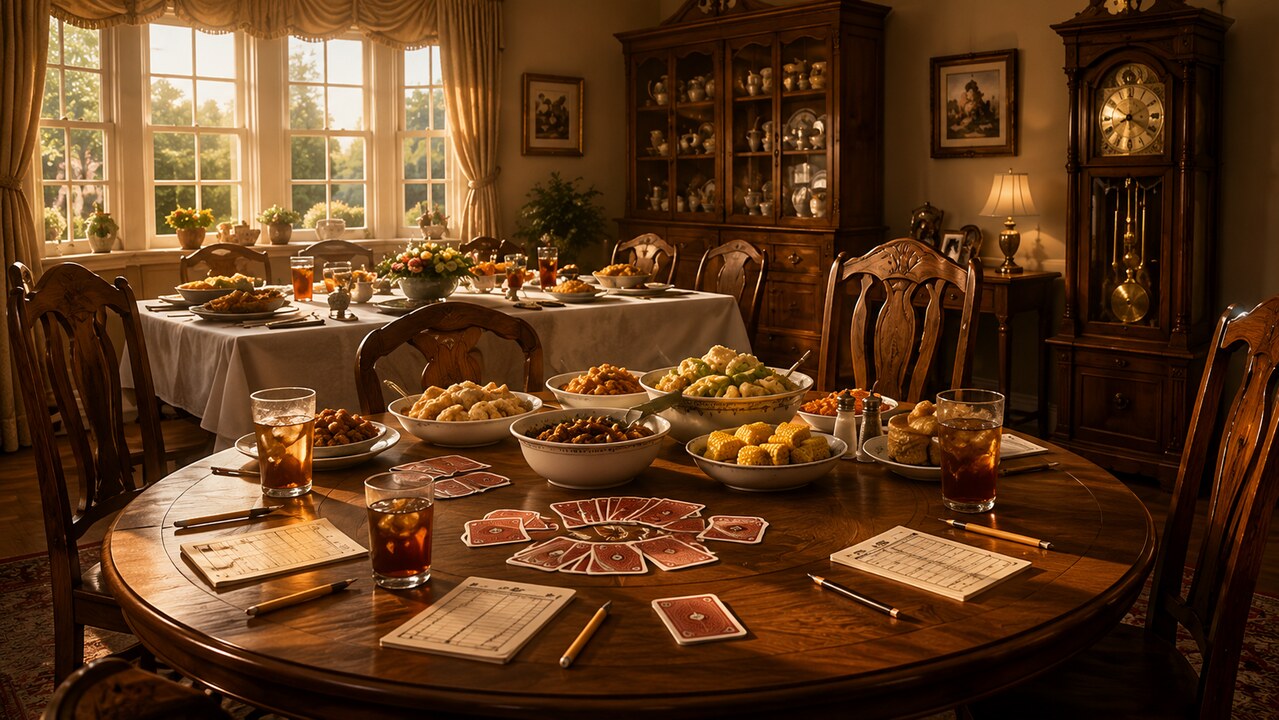
Every family that plays Bid Whist knows the feeling: the table is never just a table. It's where the generations actually sit down together — where a teenager partners with a great-aunt and learns how she thinks, where the room goes quiet for a big bid and erupts for a Boston, where belonging is something you can hold in your hand, thirteen cards at a time.
That feeling has a history. The game in this app descends from a documented, three-century line: an English parlor game, remade by Black Americans into something bolder, carried across the country by the most traveled Black workforce of its era, rooted into family life by the Great Migration, and kept alive at kitchen tables, church halls, HBCU yards, and family reunions ever since. Here is that road, era by era.
-
1742 · London
Whist gets written down
Whist — the English trick-taking ancestor of our game — had been played in taverns and parlors for generations when Edmond Hoyle published A Short Treatise on the Game of Whist in 1742. It was the first serious strategy book ever written about a card game, and it made whist the thinking person's game of the English-speaking world. We still say "according to Hoyle" today. The original 1742 treatise survives — you can read a scan of it at the Internet Archive.
-
1800s · America
The game crosses the water — and gets remade
Whist sailed to America and became the dominant card game of the nineteenth century. But in Black communities — during and after the Civil War — the game began turning into something new. Players added competitive bidding, the right to name trump, and the audacity to play the deck low as well as high. Whist was a polite game. Bid Whist was a bold one: you didn't just play your cards, you declared out loud what you and your partner were going to do with them, and then you backed it up.
-
1880s–1920s · The rails
The Pullman porters carry it everywhere
The men who worked the Pullman sleeping cars — nearly all of them Black, many of them sons of the formerly enslaved — became one of the most traveled workforces in American history. Between runs and on long overnight routes, the cards came out. Porters carried Bid Whist from city to city along every rail line in the country, planting the game in barbershops, boarding houses, and back rooms from New Orleans to Chicago to New York. Train culture soaked into the game's language — running a "Boston" is said to come from the all-night games on the long hauls. In 1925, those same porters organized the Brotherhood of Sleeping Car Porters under A. Philip Randolph — the first Black union to win a national contract in U.S. history. The men who spread this game also helped build the modern civil rights movement. That is not a coincidence. It is the same spirit: partnership, discipline, and refusing to fold.
-
1916–1970 · The Great Migration
A kitchen-table institution
As six million Black Americans left the South for cities north and west, Bid Whist traveled in the luggage. In the new neighborhoods of Chicago, Detroit, Cleveland, and Los Angeles, the card table became an anchor — someplace that felt like home when everything else was new. Chicago in particular became the game's spiritual home. Friday fish fries, rent parties, church fellowship halls, front stoops in the summer: wherever family gathered, the table was set. It's where news got told, matches got made, children learned to count and to keep their composure, and elders taught the young to think three moves ahead without ever calling it a lesson.
-
1950s–1990s · HBCUs, reunions, and rise and fly
The proving grounds
Bid Whist ran on every HBCU campus — dorm lounges, student unions, homecoming weekends — and family reunions scheduled themselves around the tournament. "Rise and fly" rules kept the tables hot: lose, and you get up so the next pair can sit down. Talk was half the game. The boasts, the signature slam of a winning card, the retelling of a Boston for decades afterward — that theater is not decoration on top of the game. It is the game, the way call-and-response is the music. By 1993 the game was so woven into Black institutional life that a California Law Review article invoked it by name — "Bid Whist, Tonk, and United States v. Fordice" — using the card table as shorthand for the cultural spaces Black communities built and owned.
-
2000s · The game goes online
New tables, same talk
Early internet game rooms put Bid Whist online, and the diaspora found each other at virtual tables at 2 a.m. the same way porters once found a game in the next railyard. In 2005, journalists Greg Morrison and Yanick Rice Lamb published Rise and Fly: Tall Tales and Mostly True Rules of Bid Whist — the first full book devoted to the game's history, lore, and table culture, told through the voices of everyday players and celebrities alike. The game had outlived every prediction and every platform.
-
Today
Forever
The tables are still going — and now there's one online built by people who know where the game came from. Bid Whist Forever exists so the game your grandmother taught you outlives us all. The venues in our app are the places the game actually lived: the dining room, the front porch, the church hall, the cookout, the reunion pavilion, homecoming. The vocabulary is the real vocabulary. The events are the gatherings we actually hold. That's the whole mission. It's in the name.
Why the table matters
Look at what this game asks of you and you'll see why it took root where it did. Bid Whist is a partnership game — you cannot win it alone, and you cannot win it without learning to hear a partner who isn't allowed to tell you what they hold. It rewards boldness backed by discipline: the bid is a promise made out loud, in front of everybody, and the scoreboard remembers whether you kept it. And it's built for the whole family — cheap as a deck of cards, deep as chess, and equally at home at a reunion pavilion or a championship table.
Partnership. Your word being your bond. Every generation at one table. That's not just a game design — that's a set of values. It's why the game was worth carrying on the rails, worth keeping through the Migration, and worth teaching to every child who could hold thirteen cards. And it's why we built this app the way we did: the events are real gatherings, the Fams are real crews, and the table always comes first. If you want the game itself, we teach it the way family does.
Sources & further reading
We keep this page honest. Where the record is lore rather than document — like where "Boston" got its name — we say so in the text.
- Edmond Hoyle, A Short Treatise on the Game of Whist (1742) — original scan The 1742 first-edition treatise, digitized by the Internet Archive.
- Encyclopaedia Britannica — Edmond Hoyle & the Whist Treatise Hoyle’s biography and the treatise’s role as the first scientific card-game text.
- Chicago Magazine — “Bid Whist: The Card Game With Chicago Roots” The game’s emergence in Black communities and Chicago as its spiritual home.
- America Comes Alive — “Bid Whist and Sleeping Car Porters” How Pullman porters spread the game along the rail lines.
- Library of Congress — Brotherhood of Sleeping Car Porters The 1925 founding under A. Philip Randolph; first Black union to win a national contract.
- Alex M. Johnson Jr., “Bid Whist, Tonk, and United States v. Fordice,” 81 Cal. L. Rev. 1401 (1993) The landmark law-review article that used the game as a symbol of Black cultural institutions — full text, open access via UC Berkeley.
- Greg Morrison & Yanick Rice Lamb, Rise and Fly: Tall Tales and Mostly True Rules of Bid Whist (Three Rivers Press, 2005) The definitive popular history and lore of the game.
- NPR — “Rise and Fly: The Story of Bid Whist” (Dec 26, 2005) Interview with the authors on the game’s history and table culture.
"Somebody taught you. Now the table's set for the next hand."
Keep it going — play nowHave family stories, photos, or corrections for this page? We'd love to hear them — and the best stories get featured. info@bidwhistforever.com